Deterministic reflexes. Composition in personality.
The "Why" — why this works
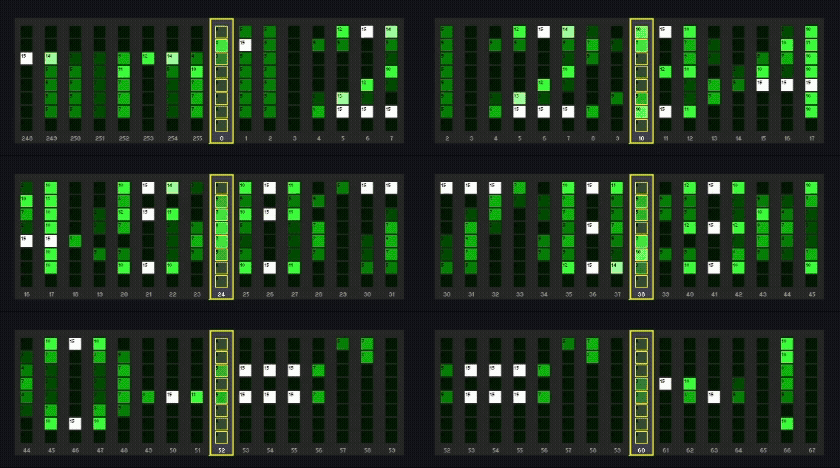
Moving from "yes/no" to multi-valued logic. 16 states (0..15) per line.
Far fewer wires with colossal growth in information density per clock. This is the physical limit of compactness for neuromorphic systems.
Decima-8 architecture is physically "friendly" with memristors — weights are not computed, they are part of channel conductivity.
Classic NoC (Network-on-Chip) are clogged with routers. Router = overhead, delays, and "traffic jams" in data.
In Decima-8 there are no routers. There is relay access to a common bus (VSB 8×0..15).
A tile (neuron/layer) doesn't "request" a data packet, it receives temporary permission to access the bus. Activation is passed like a relay baton from segment to segment.
Instead of a central processor — autonomous tile clusters communicating at signal speed.
This turns the chip from a calculator into a reflex system, where delay is determined only by silicon physics, not routing algorithm complexity.
Bakers create reflexes (.d8p) → Architects assemble personalities (EXE) → Users receive ready autonomous subjects.
Open reflexes grow through community → proprietary dictionaries are monetized → royalties from each sale.
Intelligence in the device, not in the cloud → data doesn't fly away → control with the subject, not the platform.
The wall of energy consumption and latency
High ping, network dependency
Wild energy consumption
Cannot prove, cannot certify
This is a "brain in a jar", not intelligence in a device.
(Hardware & Low-level)
Creates the "body" of intelligence
(Systems & Logic)
Builds personality from ganglia
(End-experience)
Receives a "living" device
Decima-8 is not a replacement for graphics cards.
This is a transition to a new principle.: